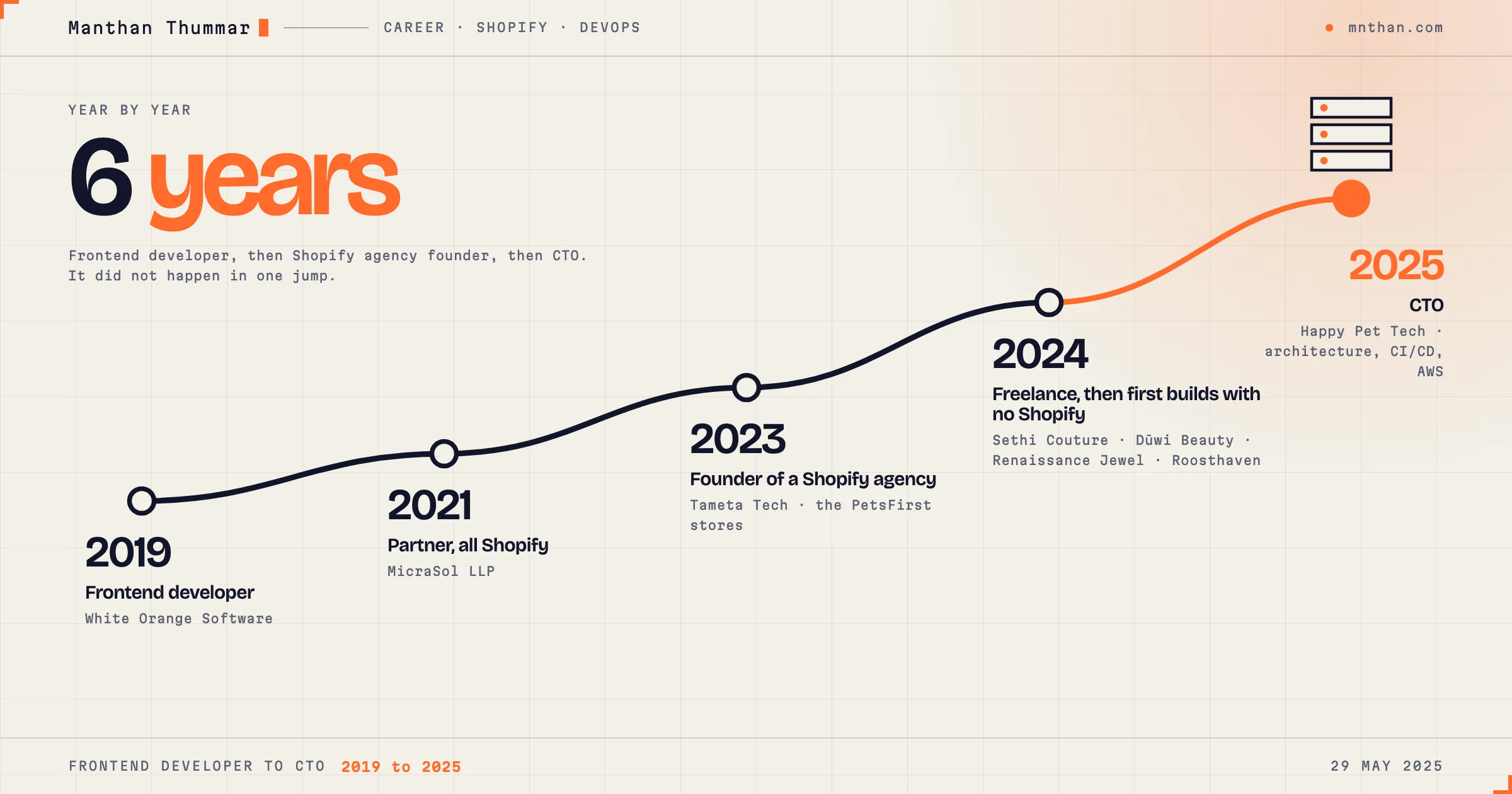
People who know me from my Shopify years are sometimes surprised when I say I now run infrastructure. It did not happen in one jump. Here is how it went.
2019
I started as a frontend developer at White Orange Software. HTML, CSS, JavaScript, and turning designs into pages.
2021
I became a partner at MicraSol LLP and my work turned fully to Shopify. Themes in Liquid, checkout flows, payment and shipping integrations. For the next few years this was my whole working day.
2023
I founded my own Shopify agency, Tameta Tech.
This was also the year of PetsFirst. I built two Shopify stores for them, a retail store and a pharmacy, and the brand went from one city to more than twenty. That project taught me something I keep using. Very little of that growth came from the theme. It came from payments that worked, delivery that reached people, and the store being found on Google.
2024
I worked as a freelance senior Shopify developer. I rebuilt the Sethi Couture store, built a custom theme for Dūwi Beauty, and in September I joined Renaissance Jewel in New York, working remotely on their store’s speed and SEO.
During these years I kept running into the same wall. A client would need something that a hosted store cannot give: a custom backend, a real database, a mobile app, a deploy pipeline. Each time I went and learned it, and each time I enjoyed that part more than the theme work.
By the end of 2024 I was taking projects that had no Shopify in them. I built Roosthaven, a real-estate platform, alone, on Next.js and Postgres. Then in early 2025 I built PetsFirst Health, a healthcare platform for the same PetsFirst brand. That was a custom build with Next.js, MongoDB and a Flutter app.
2025
Last month I joined Happy Pet Tech as CTO. It is a SaaS platform for pet-care businesses like grooming salons, boarding places, vet clinics and pet shops. I am responsible for the architecture, and I also run the infrastructure: the CI/CD pipeline, AWS, and keeping the product up.
The work feels very different from a store. If I made a mistake on a storefront, one page looked wrong or one sale was lost. If I make a mistake in infrastructure, the product can go down for every customer, and it may happen at night when nobody is looking. That is the reason I care so much about automated deploys and rollbacks now.
I still use what Shopify taught me. I still look at everything from the side of the person using it, and I still get stuck on small details like a slow page or one extra field in a form. Those habits came from years of watching what makes a customer leave a checkout.